© 2024 Nurturing Humanity Research Institute
CONTACT US
Nurturing Humanity Research Institute, dba Pleasure Positive Institute
1125 Howe St, Suite 915, Vancouver BC
(+1) 778 806 1219

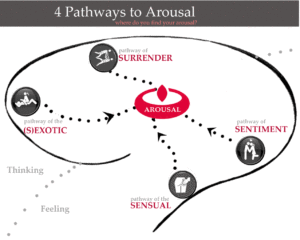
What are the Four Erotic Brain Modes?
We all use each one of these erotic modes to some degree, but most of us have one or two that are dominant.
Find out more:
Take the Test – find out your initiation style
Does sex really change after the honeymoon?
What happens to sex in long-term relationships
Does sex really change after the honeymoon? The simple answer is yes, the beginning of a relationship is a time of “passionate love” where the desire to be close it at it’s highest. Because of an elixir of factors, sexual frequency, sexual desire/passion and sexual satisfaction all peak in this first stage, often called the “honeymoon” period. And then the spark seems to peter out. But what actually is changing. How fast does it change? And can we stop it?
How fast does it happen?
It is widely agreed that sexual frequency and satisfaction decreases within the first two years; however, there has been a discrepancy over the rate of decline. Some have found a sharp decline in the first few months of the relationship (Call, et al, 1995), while others have found a more gradual decline over the first few years (Liu, 2002; Fredrick, 2017; Schmiedeberg, 2016).
It depends on what part of sex we are talking about. I have separated out (below) what the research says changes in sex over time in a long-term relationship.
What changes?
There is reason to be hopeful. If you tend to your sexual spark, it is possible to make it grow again. It might look different than at the beginning, but it could grow even stronger than it was before.
Resources:
Baumeister, R. F., & Bratslavsky, E. (1999). Passion, intimacy, and time: Passionate love as a function of change in intimacy. Personality and Social Psychology Review, 3(1), 49-67.
Call, V., Sprecher, S., & Schwartz, P. (1995). The incidence and frequency of marital sex in a national sample. Journal of Marriage and the Family, 57(3), 639-652.
Frederick, D. A., Lever, J., Gillespie, B. J., & Garcia, J. R. (2017). What keeps passion alive? Sexual satisfaction is associated with sexual communication, mood setting, sexual variety, oral sex, orgasm, and sex frequency in a national US study. Journal of Sex Research, 54(2), 186-201.
Hatfield, Elaine, Pillemer, Jane T., O’Brien, Mary U., & Le, Yen-Chi L. (2008). The endurance of love: passionate and
companionate love in newlywed and long-term marriages. Interpersona 2(1), 35-64.
James, W. H. (1981). The honeymoon effect on marital coitus. Journal of Sex Research, 17(2), 114-123.
Liu, C. (2003). Does quality of marital sex decline with duration?. Archives of Sexual Behavior, 32(1), 55-60.
Mark, K. P., & Lasslo, J. A. (2018). Maintaining sexual desire in long-term relationships: A systematic review and conceptual model. Journal of Sex Research, 55(4-5), 563-581.
Moor, A., Haimov, Y., & Shreiber, S. (2021). When desire fades: Women talk about their subjective experience of declining sexual desire in loving long-term relationships. Journal of Sex Research, 58(2), 160-169.
Muise, A., Impett, E. A., Kogan, A., & Desmarais, S. (2013). Keeping the spark alive: Being motivated to meet a partner’s sexual needs sustains sexual desire in long-term romantic relationships. Social Psychological and Personality Science, 4(3), 267-273.
Schmiedeberg, C., & Schröder, J. (2016). Does sexual satisfaction change with relationship duration?. Archives of Sexual Behavior, 45(1), 99-107.
Being pressured for sex is no cake-walk!
The difficulties of being the person doing the rejecting, the Rejector, often go unrepresented. After all, the Rejector seems to have all the power. But the experience for them can be equally, or even more, uncomfortable. The Rejector tends to feel guilt, shame, obligation and even anger. “I can feel so conflicted,” reported Chandra when asked what it was like to be asked for sex all of the time. “I feel so much love for Ray, but sometimes I just don’t feel sexual.” Chandra said she didn’t know how to handle these moments. Rejectors most often describe feeling frustrated at themselves for not being horny at the drop of a hat, or even angry at their partner for assuming that they should be. But the most common and destructive feeling a Rejector reports is … pressure. Pressure is the enemy of sexual desire. And it is toxic to any sex life. Sexual pressure is NOT an aphrodisiac for most people. Sexual pressure can come in overt ways, such as asking, begging or badgering. Or more subtle forms, such as hurt feelings, poutiness or withdrawal.
Why can sexual pressure feel so toxic? Sexual desire requires a certain autonomy. In other words, sexual feelings need to come from inside ourselves, in a relaxed and non-pressured environment. Sexual arousal needs choice, agency and creativity to work properly. And when people are repeatedly pressured, they can feel disrespected, overwhelmed and inadequate.
Over time the body learns to connect sexual advances with these negative emotions and shuts down any sexual feelings even before they get started.
For some Initiators, however, sexual pressure can feel like part of the “game of seduction.” A select group of people like the challenge and will increase the pressure with the good intentions of “playing the seduction game.” A small group of Rejectors will also feel aroused by this game and enjoy being coaxed into sex. The trick is understanding whether pressure feels like positive pressure, and therefore, a game, or whether it just feels like an unwanted pressure to be avoided at all costs. Sexual communication is key!